|
Our ISO9000 certification solution streamlines the
path to ISO 9000 compliance. Paired with our team of consultants, our
powerful application will guide you through the entire process of building
a Quality Management System (QMS) from the ground up. Develop, Improve
and Implement your QMS with us, you will always have access to a leading
consultant who will act as your complete knowledge resource throughout
the certification and automation processes. Promote the importance of
Quality, Identify and Meet your customer requirements and Enhance Customer
Satisfaction. Let us help you Prepare for your ISO 9000 Certification.
We offer an introduction to Six Sigma and how it relates to the changes
in ISO 9001:2000.
Following is a detailed introduction to the
final version of ISO 9001:2000. However, it does not present the entire
detailed standard. If you need a detailed and complete interpretation
of ISO 9001:2000, please Sign up. Whether you're looking for a complete
solution to Six Sigma certification or you want to maximize your existing
management system through automation, we have a solution to meet your
needs.
System Requirements
- Establish your quality system Develop
your quality management system Identify the processes that make up
your quality system.
Describe your quality management processes.
- Implement your quality management
system Use quality system processes.
Manage process performance.
- Improve your quality management system
Monitor process performance.
Improve process performance.
- Document your quality system 4.2.1
Develop quality system documents Develop documents to implement your
quality system.
Develop documents that reflect what your organization does.
- Prepare quality system manual Document
your procedures.
Describe how your processes interact.
Define the scope of your quality system.
- Control quality system documents Approve
documents before you distribute them.
- Provide the correct version of documents
at points of use.
Review and re-approve documents whenever you update them.
Specify the current revision status of your documents.
Monitor documents that come from external sources.
Prevent the accidental use of obsolete documents.
Preserve the usability of your quality documents.
- Maintain quality system records Use
your records to prove that requirements have been met.
Develop a procedure to control your records.
Ensure that your records are useable.
Management
Requirements
- Support quality Promote the importance
of quality Promote the need to meet customer requirements.Promote
the need to meet regulatory requirements. Promote the need to meet
statutory requirements.
- Develop a quality management system
Support the development of a quality system. Formulate your organization's
quality policy.
Set your organization's quality objectives.
Provide quality resources.
- Implement your quality management
system Provide resources to implement your quality system.
Encourage personnel to meet quality system requirements.
- Improve your quality management system
Perform quality management reviews.
Provide resources to improve the quality system.
- Satisfy your customers Identify customer
requirements Expect your organization to identify customer requirements.
Meet your customers' requirements
Expect your organization to meet customer requirements.
Enhance customer satisfaction Expect your organization to enhance
customer satisfaction.
- Establish a quality policy Define your
organization's quality policy Ensure that it serves your organization's
purpose. Ensure that it emphasizes the need to meet requirements.
Ensure that it facilitates the development of quality objectives.
Ensure that it makes a commitment to continuous improvement.
Manage your organization's quality policy Communicate your policy
to your organization. Review your policy to ensure that it is still
suitable.
- Carry out quality planning. Formulate
your quality objectives Ensure that objectives are set for functional
areas. Ensure that objectives are set at organizational levels. Ensure
that objectives facilitate product realization.
Ensure that objectives support the quality policy. Ensure that objectives
are measurable.
- Plan your quality management system
Plan the development of your quality management system. Plan the implementation
of your quality management system. Plan the improvement of your quality
management system. Plan the modification of your quality management
system.
- Control your quality system. Define
responsibilities and authorities Clarify responsibilities and authorities.
Communicate responsibilities and authorities.
- Appoint management representative.
Oversee your quality management system. Report on the status of your
quality management system.
Support the improvement of your quality management system.
- Support internal communications Ensure
that internal communication processes are established. Ensure that
communication occurs throughout the organization.
- Perform management reviews. Review
quality management system Evaluate the performance of your quality
system. Evaluate whether your quality system should be improved.
- Examine management review inputs Examine
audit results. Examine product conformity data. Examine opportunities
to improve.
Examine feedback from customers. Examine process performance information.
Examine corrective and preventive actions. Examine changes that might
affect your system. Examine previous quality management reviews.
- Generate management review outputs
Generate actions to improve your quality system. Generate actions
to improve your products. Generate actions to address resource needs.
Resource
Requirements
- Provide quality resources Identify
quality resource requirements Identify resources needed to support
the quality system. Identify resources needed to improve customer
satisfaction. Provide quality
system resources Provide resources needed to support the quality system.
Provide resources needed to improve customer satisfaction.
- Provide quality personnel. Use competent
personnel Ensure that your personnel have the right experience. Ensure
that your personnel have the right education. Ensure that your personnel
have the right training.
Ensure that your personnel have the right skills.
- Support competence Define acceptable
levels of competence. Identify training and awareness needs. Deliver
training and awareness programs.
Evaluate effectiveness of training and awareness. Maintain a record
of competence.
- Provide quality infrastructure Identify
infrastructure needs Identify building needs. Identify workspace needs.
Identify hardware needs.
Identify software needs. Identify utility needs. Identify equipment
needs.
Identify support service needs.
Provide needed infrastructure Provide needed buildings. Provide needed
workspaces. Provide needed hardware.
Provide needed software. Provide needed utilities. Provide needed
equipment. Provide needed support services.
Maintain your infrastructure Maintain your buildings. Maintain your
workspaces. Maintain your hardware. Maintain your software. Maintain
your utilities. Maintain your equipment. Maintain your support services.
- Provide quality environment Identify
needed work environment Identify factors needed to ensure products
meet requirements. Manage needed
work environment Manage factors needed to ensure products meet requirements.
Realization
Requirements
- Control realization planning Plan product
realization processes Define product quality objectives and requirements.
Identify product realization needs and requirements.
Develop product realization processes Develop product realization
documents. Develop product realization record keeping systems. Develop
methods to control quality during product realization.
- Control customer processes. Identify
customers' product requirements Identify the requirements that customers
want you to meet. Identify the requirements that are dictated by the
product's use. Identify the requirements that are imposed by external
agencies. Identify the requirements that your organization wishes
to meet.
- Review customers' product requirements
Review requirements before you accept orders from customers. Maintain
a record of your product requirement reviews. Control changes in product
requirements.
- Communicate with your customers Develop
a process to control communications with customers. Implement your
customer communications process.
- Control product development. Plan design
and development Define your product design and development stages.
Clarify design and development responsibilities and authorities. Manage
interactions between design and development groups. Update your design
and development plans as changes occur.
- Define design and development inputs
Specify product design and development inputs. Record product design
and development input definitions. Review product design and development
input definitions.
- Generate design and development outputs
Create product design and development outputs. Approve design and
development outputs prior to release. Use design and development outputs
to control product quality.
- Carry out design and development reviews
Perform product design and development reviews. Record product design
and development reviews. Perform
design and development verifications Carry out product design and
development verifications. Record product design and development verifications.
Conduct design and development
validations Perform product design and development validations. Record
product design and development validations.
Manage design and development changes Identify changes in product
design and development. Record changes in product design and development.
Review changes in product design and development. Verify changes in
product design and development.
Validate changes in product design and development. Approve changes
before they are implemented.
- Control purchasing function. Control
purchasing process Ensure that purchased products meet requirements.
Ensure that suppliers meet requirements.
Document product purchases Describe the products being purchased.
Specify the requirements that must be met.
Verify purchased products Verify purchased products at your own premises.
Verify purchased products at suppliers' premises (when required).
- Control operational activities. Control
production and service provision Control production and service processes.
Control production and service information. Control production and
service instructions. Control roduction and service equipment. Control
production and service measurements. Control production and service
activities. Validate production
and service provision Prove that special processes can produce planned
outputs. Prove that process personnel can produce planned results.
Prove that process equipment can produce planned results.
Identify and track your products Establish the identity of your products
(when appropriate). Maintain the identity of your products (when appropriate).
Identify the status of your products (when appropriate).
Record the identity of your products (when required).
Protect property supplied by customers Identify property supplied
to you by your customers. Verify property supplied to you by your
customers.
Safeguard property supplied to you by your customers.
Preserve your products and components Preserve products and components
during internal processing. Preserve products and components during
final delivery. Control monitoring
devices Identify monitoring and measuring needs Identify the monitoring
and measuring that should be done.
Select monitoring and measuring devices Select devices that meet your
monitoring and measuring needs.
Calibrate monitoring and measuring devices Perform calibrations. Record
calibrations. Protect monitoring
and measuring devices Protect your devices from unauthorized adjustment.
Protect your devices from damage or deterioration.
Validate monitoring and measuring software Validate monitoring and
measuring software before you use it. Revalidate monitoring and measuring
software when necessary. Use
monitoring and measuring devices Use devices to ensure that your products
meet requirements.
Remedial
Requirements
- Perform remedial processes Plan remedial
processes Plan how remedial processes will be used to assure conformity.
Plan how remedial processes will be used to improve the system.
Implement remedial processes Use remedial processes to demonstrate
conformance.
Use remedial processes to improve quality management system.
- Monitor
and measure quality. Monitor and measure customer satisfaction Identify
ways to monitor and measure customer satisfaction. Monitor and measure
customer satisfaction. Use customer satisfaction information.
Plan and perform regular internal audits Set up an internal audit
program. Develop an internal audit procedure. Plan your internal audit
projects. Perform regular internal audits. Solve problems discovered
during audits. Verify that problems have been solved.
Monitor and measure quality processes Use suitable methods to monitor
and measure your processes. Take action when your processes fail to
achieve planned results. Monitor
and measure product characteristics Verify that product characteristics
are being met. Keep a record of product monitoring and measuring activities.
- Control nonconforming products Develop
a procedure to control nonconforming products Define how nonconforming
products should be identified. Define how nonconforming products should
be handled. Identify and control
your nonconforming products Eliminate or correct product nonconformities.
Prevent the delivery or use of nonconforming products. Avoid the inappropriate
use of nonconforming products.
Re-verify nonconforming products that were corrected Prove that corrected
products now meet requirements.
Control nonconforming products after delivery or use Control events
when you deliver or use nonconforming products.
Maintain records of nonconforming products Describe your product nonconformities.
Describe the actions taken to deal with nonconformities.
- Analyze quality information Define
quality management information needs Define the information you need
to evaluate your quality system.
Define the information you need to improve your quality system.
Collect quality management system data Monitor and measure the suitability
of your quality system. Monitor and measure the effectiveness of your
quality system. Provide quality
management information Provide information about your customers. Provide
information about your suppliers. Provide information about your products.
Provide information about your processes.
- Make quality improvements. Improve
quality management system Use your audits to generate improvements.
Use your quality data to generate improvements. Use your quality policy
to generate improvements.
Use your quality objectives to generate improvements. Use your management
reviews to generate improvements. Use your corrective actions to generate
improvements. Use your preventive actions to generate improvements.
Correct actual nonconformities
Review your nonconformities. Figure out what causes your nonconformities.
Evaluate whether you need to take corrective action. Develop corrective
actions to prevent recurrence. Take corrective actions when they are
necessary. Record the results that your corrective actions achieve.
Examine the effectiveness of your corrective actions.
- Prevent potential nonconformities Detect
potential nonconformities.
Identify the causes of potential nonconformities. Study the effects
of potential nonconformities. Evaluate whether you need to take preventive
action. Develop preventive actions to eliminate causes. Take preventive
actions when they are necessary. Record the results that your preventive
actions achieve. Examine the effectiveness of your preventive actions
We offer an introduction to Six Sigma and how
it relates to the changes in ISO 9001:2000. It is reasonable to carry
out the Six Sigma implementation as a six-phase process. Phases from
one to four are establish Six Sigma, and phases from five to six are
for realization of Six Sigma. Look at the Six Sigma implementation model
below.
Figure 1
First phase is to establish commitment
of supreme command. This means training the principles and tools to
senior management. This should be followed by a development of a management
infrastructure to support the Six Sigma. One tool to monitor the change
in management is to use QPR ScoreCard.
Second phase is information gathering.
This translates into intensive communication with customers, suppliers,
and employees. Information about the conditions of the processes which
should be improved, for example, supply chain is obtained from customers
and suppliers. Analysis of the information helps to identify the obstacles
standing in the way of success.
Training the whole staff in the organization
is the third phase on the way to Six Sigma. The training needs are assessed,
and the training is conducted from top-to-bottom. Training levels can
be, for example, black belt and green belt. Black belt are the all-day
problem solvers who also operate as team leaders in Six Sigma projects.
Green belts are the team members in Six Sigma projects.
Fourth phase of the Six Sigma implementation
process is to develop a monitoring system. Because one main goal is
continuous improvement, the framework of the management has to support
that end. After the framework is in order, it is time to develop a monitoring
system. Adequate measures should be created for strategic goals and
key business processes. Measures can be internal and/or external, for
example, customer satisfaction. One framework element is, for example,
a balanced scorecard.
The realization of the Six Sigma
starts from phase five when business processes to be improved are chosen.
The current key process in general level are mapped and problems identified,
and valueless activities and subprocesses are terminated. Then the processes
that need improvement are chosen and a Six Sigma project is defined.
One project concept is DMAIC (Figure 2.) where the problems of the process
that need improving are first defined and then the goals that should
be achieved during the project are determined. The existing system needs
to be measured. Establish valid and reliable measures and carry out
a research. Analyze the findings and define the gap between �as-is�
and �should-be�.
After analysis, the system starts
to create new ways of doing things. Improve the processes and validate
them by simulations and statistical methods. Before implementing the
improvements, create a project plan and communicate the changes through
the organization. Institutionalize the new improved system by modifying
the management system. This means modifying compensation and incentive
systems, Enterprise Resource Planning (ERP), budgets, etc. Establish
a proper documentation system, for example, ISO 9001:2000, and monitor
the system. Finally, transfer the information, which means that the
findings of the project are assessed for relevance to other projects.
Six Sigma is a business method for
improving quality by removing defects and their causes in business process
activities. It concentrates on those outputs which are important to
customers. The method uses various statistical tools to measure business
processes. In technical terms, Six Sigma means that there are 3.4 defects
per million events. The main goal is continuous improvement. Six Sigma
is carried out as projects. Most common type is the DMAIC method (Define,
Measure, Analyze, Improve, Control). First, the project and the process
to be improved are defined after which the performance of the process
is measured. The data is then analyzed and bottle-necks and problems
identified. After analysis, improvement program is defined and defects
removed. This development program is controlled by a management group.
After DMAIC circle it is time to define a new project.
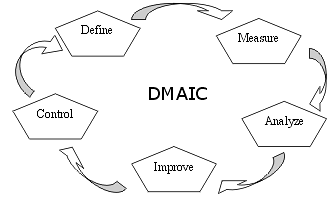
Figure 2
Sign
up
|